Notice: Function _load_textdomain_just_in_time was called incorrectly. Translation loading for the acf domain was triggered too early. This is usually an indicator for some code in the plugin or theme running too early. Translations should be loaded at the init action or later. Please see Debugging in WordPress for more information. (This message was added in version 6.7.0.) in /var/www/html/wp-includes/functions.php on line 6131

Notice: Function _load_textdomain_just_in_time was called incorrectly. Translation loading for the post-smtp domain was triggered too early. This is usually an indicator for some code in the plugin or theme running too early. Translations should be loaded at the init action or later. Please see Debugging in WordPress for more information. (This message was added in version 6.7.0.) in /var/www/html/wp-includes/functions.php on line 6131

Notice: Function _load_textdomain_just_in_time was called incorrectly. Translation loading for the rank-math domain was triggered too early. This is usually an indicator for some code in the plugin or theme running too early. Translations should be loaded at the init action or later. Please see Debugging in WordPress for more information. (This message was added in version 6.7.0.) in /var/www/html/wp-includes/functions.php on line 6131

Notice: Function _load_textdomain_just_in_time was called incorrectly. Translation loading for the rank-math domain was triggered too early. This is usually an indicator for some code in the plugin or theme running too early. Translations should be loaded at the init action or later. Please see Debugging in WordPress for more information. (This message was added in version 6.7.0.) in /var/www/html/wp-includes/functions.php on line 6131
Flow Line Fundamentals: The Energy Sector Operations - GET Global Group

Flow Line Fundamentals: The Energy Sector Operations

Blog banner5 1

Efficiency, precision, and reliability define a favorite operation in the energy sector. Flow lines, though often taken for granted, are the very web that brings together production in oil and gas. They are primary components in upstream operations because they facilitate the flow and transportation of hydrocarbons from the well to upstream processing. Understanding flow lines is at the core of optimizing operations, reducing downtime, and ensuring safety in the field.

What Are Flow Lines?

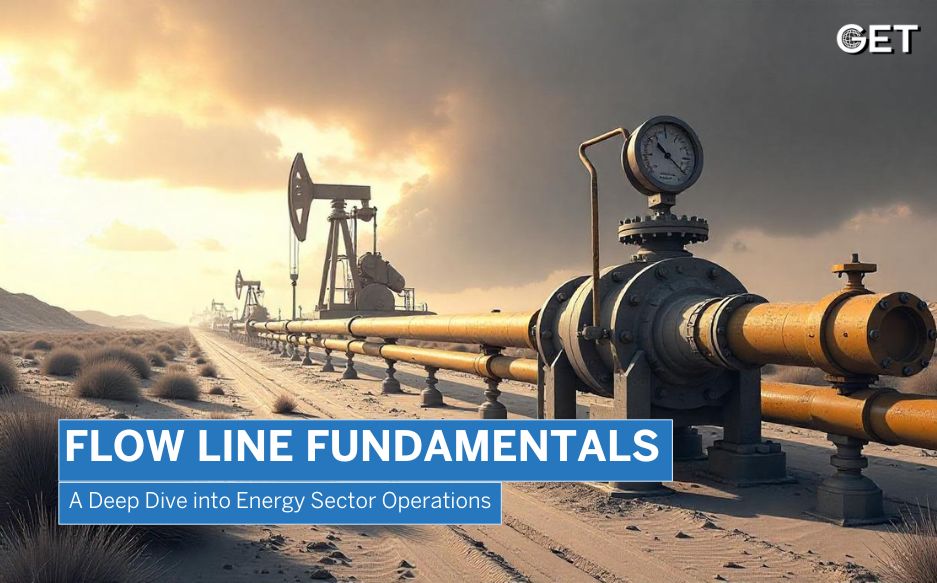
Flow lines are pipelines carrying crude oil, natural gas, or multiphase fluids from the wellhead to gathering stations, separators, or processing plants. Unlike the transportation pipelines through which processed hydrocarbons move for miles, flow lines are usually shorter and cater for higher pressures and temperatures. They are very critical during early-stage production and play a huge role in the overall efficiency of the system.

Key Components of Flow Lines

  1. Pipeline Material & Design: Generally, flow lines are made from materials like carbon steel or austenitic stainless steel and corrosion-resistant alloys depending on the characteristics of the transported fluids.
  2. Insulation & Coating: Keeping these lines away from corroding and heat loss through insulation or coating by using an enhanced longevity or efficient enhancing material.
  3. Control & Safety Valves: Municipal and these control the flow rates and pressure in order to prohibit any leak, rupture, or hazard in the operations.
  4. Pigging systems: Regular pigging (maintenance using “pigs” to clean and inspect pipelines) will ensure integrity and performance of the line.
  5. Corrosion monitoring sensors: Most fluids aggressive among minerals are then monitored by these tools that usually give an alarm to the minimal level of damaged pipeline. 

Role of Flow Lines in Energy Operations

Flow lines serve multiple purposes in oil and gas fields, directly affecting production performance and safety. Here is how they fit into broader operations: 

  1. Transporting Hydrocarbon Efficiently 

When hydrocarbons are extracted, flow lines ensure the transport of the material in a safe and rapid manner to processing units. The quality of flow line infrastructure determines production rates and bottlenecks in the supply chain. 

  1. Pressure Management & Fluid Handling 

The fluids that emerge from the wells mostly have a mix of oil, gas, water, and sand. Flow lines are designed to accommodate multiphase flow and then separate these constituents in downstream processing stages. 

  1. Environment Preservation 

Leak-proof and properly maintained flow lines reduce environmental hazards while taking care of avoiding spills and emissions. Periodic inspection and determination further fosters sustainability and compliance with legal frameworks.

  1. Cost Optimization & Reliability

The efficiency of operations becomes a function of the reliability of flow lines: downtime due to a leak, blockage, or corrosion can mean financial loss. In the long term, investing in strong materials and predictive maintenance can ensure cost savings.

Challenges and Innovations in Flow Line Management

The complexity of flow lines brings all kinds of operational challenges that invite innovative solutions. 

  • Corrosion and scaling: The damage incurred due to exposure to high temperatures, saline water, and CO2 occurs very quickly. Advanced coating and inhibitor injection is now widely used.
  • Flow assurance issues: Midstream development activities such as hydrate formation, wax deposition, and sand production hinder flow lines. Chemical additives and heated pipelines minimize such risks.
  • Digital Monitoring and IoT Integration: With the introduction of these smart flow lines, the real-time monitoring of data makes predictive maintenance with less chance of unplanned shutdowns.
  • Carbon Footprint Reduction: Apart from just being sustainable in its approach, the energy companies have come up with green flow line solutions, for example, composite pipelines needing less energy for maintenance and operation.

Best Practices in Flow Line Management 

A proactive approach should be adopted by companies in the management of flow lines since operational excellence requires this: 

  • Routine Inspections: These include regular pigging, ultrasonic testing, and inline smart pigging which improve the reliability.
  • Real-time monitoring: Sensors make it possible to have instant feedback on pressure variations, temperature fluctuations, and corrosion rates. 
  • Industry Standards: Compliance to standards such as API (American Petroleum Institute) and ISO will ensure pipeline safety and efficiency. 
  • Strategic Maintenance Program: A notified maintenance schedule puts unexpected failures in check. 

GET Global Group: A Leader in Flow Line Solutions 

Trusted partner in energy GET Global Group, is giving the latest innovative solutions in flow line management. GET Global Group established its name by having extensive learning with oil and gas operations to ensure that the flow lines would be designed, maintained, and optimized under industry standards. 

Read Also- Powering Projects with the Right People

By bringing advanced technology application, predictive analytics, and sustainable engineering practices to bear, GET Global Group empowers energy companies to become more efficient and mitigate operational risks while attaining significant cost savings in the long run. Whether it concerns corrosion prevention, digital monitoring, or pressure management, GET Global Group has tailored solutions that drive innovation in flow line operations.

Conclusion

A fundamental part of the operational framework of the energy sector, flow lines serve an eminent role in hydrocarbon transport, ensuring safety, and cost savings. While the industry continues its burgeoning advancement in terms of digitalization and sustainability, mastering the groundwork of flow lines continues to form a bedrock of efficient oil and gas production. Companies like GET Global Group who invest in innovative flow line technologies will not only achieve improved efficiency in production but also continue to flourish in time toward a more sustainable and safer energy landscape.
More Readings

Related blogs

Upstream oil and gas service provider

Challenges and Opportunities for Oilfield Service Providers in the Middle East

By Get global | March 18, 2026

The Middle East has always been the heartbeat of the global energy industry. It holds some of the world’s largest oil and gas reserves. And for decades, it has attracted investment from every corner of the globe. But the landscape is changing. Fast. Today, oilfield service providers operating in this […]

Upstream oil and gas operation

Oil and Gas Exploration and Production Operations

By Get global | March 16, 2026

The initial point of the energy supply chain is oil and gas exploration and production. It is at this point that firms seek reserves, drill wells, and pump up hydrocarbons to the surface. The financial exposure is real. An offshore exploration well can cost more than $100 million. Many wells […]

Upstream oil and gas industry

How Oilfield Service Companies Support Upstream Operations in the Middle East

By Get global | March 11, 2026

The Middle East has always been one of the key regions for the oil and gas industry with some of the largest hydrocarbon reserves in the world. Upstream exploration and production have been a major contributor to economic growth and energy development for many Middle Eastern countries. For instance, cities […]
Upstream oil and gas job in the Middle East

Top Oil & Gas Jobs in the Middle East: Skills, Salaries, and Career Opportunities

By Get global | March 10, 2026

The Middle East operates as the core of the oil and gas industry since most energy industry developments throughout the world converge at this particular region. The region provides career opportunities which offer exceptional salary packages and thrilling work experiences throughout its Saudi Arabian deserts and Abu Dhabi urban centers […]

Upstream oil and gas companies

National Oil Companies Leading the Middle East Energy Sector

By Get global | March 6, 2026

If you want to understand the global energy industry — really understand it — you have to start in the Middle East. Not because it’s a trendy thing to say, but because the numbers don’t lie. This region holds over 48% of the world’s proven crude oil reserves. And the […]