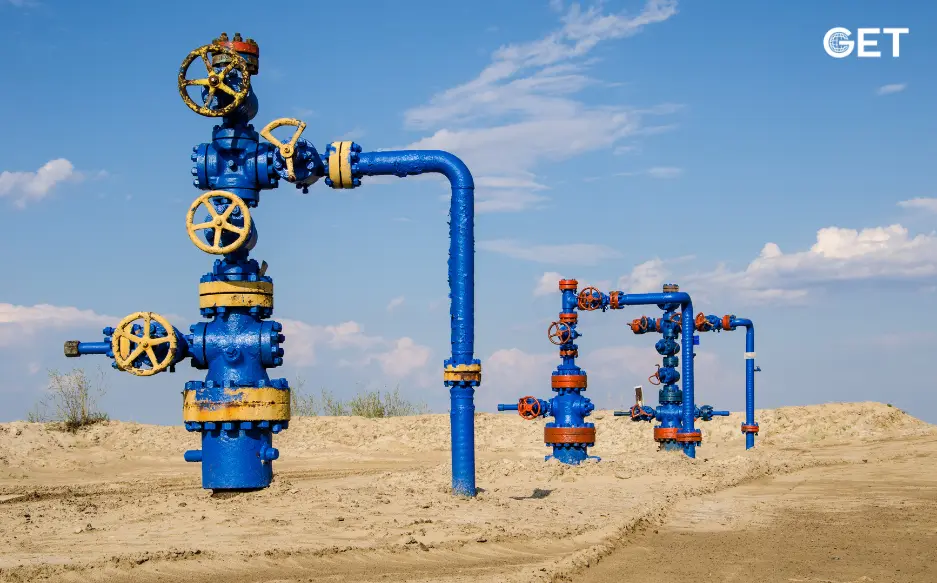
If you have ever spent time on a rig or even walked past a producing well in the oil and gas industry, you have probably heard the terms wellhead and Christmas tree tossed around like everyone is supposed to automatically know the difference. A lot of newcomers nod along even when they are not fully sure which part does what. And honestly, that is normal. They sit on top of each other, they both deal with pressure, and from a distance the whole setup can look like one single unit.
But once you work with drilling or production teams even for a week in the upstream oil and gas environment, you realise the two pieces of equipment are nothing alike in purpose. One holds the well together. The other tells the well what to do. That simple difference actually clears up most of the confusion.
A wellhead is installed early, when the crew is still drilling. It is almost like the skeleton or the anchor of the entire well. Everything rests on it, literally. The casing strings hang from it. The seals inside it keep whatever pressure the formation throws at you from escaping to the surface. If the wellhead is not right, the well will not behave right later.
There is nothing glamorous about a wellhead. It does not move. It does not have fancy handles. It just sits there and holds the structure steady. But without it, you cannot mount a blowout preventer, you cannot continue drilling safely, and you definitely cannot install the tree later. Many people think the well starts getting serious only when the Christmas tree arrives, but the real stability comes from the wellhead long before that day.
If you had to compare it to something simple, think of it as the frame of a house. Nobody compliments the frame, but if it is weak, the entire building is a problem.
Once the well is drilled and completed, the atmosphere changes. The heavy drilling machinery leaves, and the team starts preparing for the part that actually brings money in: production. This is when the Christmas tree shows up.
Compared to the wellhead, the tree looks more lively. It has valves sticking out, gauges, controls, and the choke that basically decides how fast the well gets to breathe. It is the part operators actually touch, turn, open, close, and check every day. If the wellhead is the house frame, the Christmas tree is the set of switches and taps that let you use it.
The valves on the tree decide whether the well flows, stays shut, or flows at a controlled rate. The swab valve gives access if the team needs to run tools in. The gauges show what the well is feeling at that moment. You can tell a lot about a well just by standing near its tree for a minute.
Here is the simplest way to separate the two in your head:
One cannot do the other’s job. A wellhead cannot tell a well to slow down its flow. A Christmas tree cannot hold the casing strings or carry the weight the wellhead does. They were built for different reasons, and that difference becomes clearer the more time you spend around actual operations in the oil and gas sector.
Another point many people forget: the wellhead faces a very steady type of stress from the earth. The tree deals with a more unpredictable type of stress because production never stays the same from day to day. So the maintenance and inspection style for both ends up being quite different.
Knowing which is which might sound like trivia, but it really does matter. If someone reports a “problem at the wellhead” when they actually mean a tree valve is leaking, the team will react in a totally different way. Mentioning the wrong part can delay the work or send the wrong crew.
When you prepare daily reports, noting the right equipment is a big deal. And when you troubleshoot, identifying whether the issue is coming from the foundation of the well or from the flow control equipment saves hours of guesswork.
Also, when you talk to people across departments, terms matter. Drilling, completions, production, and maintenance teams all use the words differently based on the stage they operate in. Being clear helps everyone stay aligned across the entire upstream oil and gas workflow.
Read Also- Essential Oil and Gas Industry Terms Every Upstream Professional Should Know
At the end of the day, the two systems are partners. The wellhead gives the well its strength and sealing. The Christmas tree gives it control and direction. If either one is weak or not maintained, the well is not safe or productive.
Most wells in the world will live their entire life standing on a wellhead and flowing through a Christmas tree. Understanding them is not just technical knowledge. It is basic field awareness for anyone working in oil and gas.
By Get global | June 30, 2026

By Get global | June 29, 2026
The oil and gas industry is complex and high-risk, making it essential for operators to select oilfield service partners based on more than just price or equipment availability. In the upstream sector—especially in the Middle East—Health, Safety, and Environmental (HSE) performance is now a key factor in decision‑making. Strong HSE […]

By Get global | June 29, 2026

By Get global | June 29, 2026
The Middle East has always been one of the key regions for the oil and gas industry with some of the largest hydrocarbon reserves in the world. Upstream exploration and production have been a major contributor to economic growth and energy development for many Middle Eastern countries. For instance, cities […]
By Get global | June 29, 2026